Module
Agents Put the knowledge that is already written — protocols, TARPs, manuals, reports — to work at the moment it is needed: when the ground shakes, when a sensor crosses a band, when someone needs a chart they would otherwise request by email.
It's three in the morning and the ground just shook. Where is the TARP?
The problem
What happens today at a facility
A tailings facility has a procedure for almost everything. The problem is not that one is missing: it is the time between the event and the procedure. At three in the morning, after an earthquake, someone has to remember which TARP applies, find it, read which level corresponds to that magnitude and distance, and notify the right people.
That gap fills up with phone calls. And what gets lost is not the action — it gets done in the end — but the record: what was looked at, with which information in view, and who decided.
The agents in Twin Mining TMS predict nothing. They do something more useful: they find the procedure you already wrote, walk it at the moment it is needed, propose, cite the document and page, and sign. A person decides.
What it does
Capabilities, with their nuance.
-
Post-seismic response over the TARP that already existed
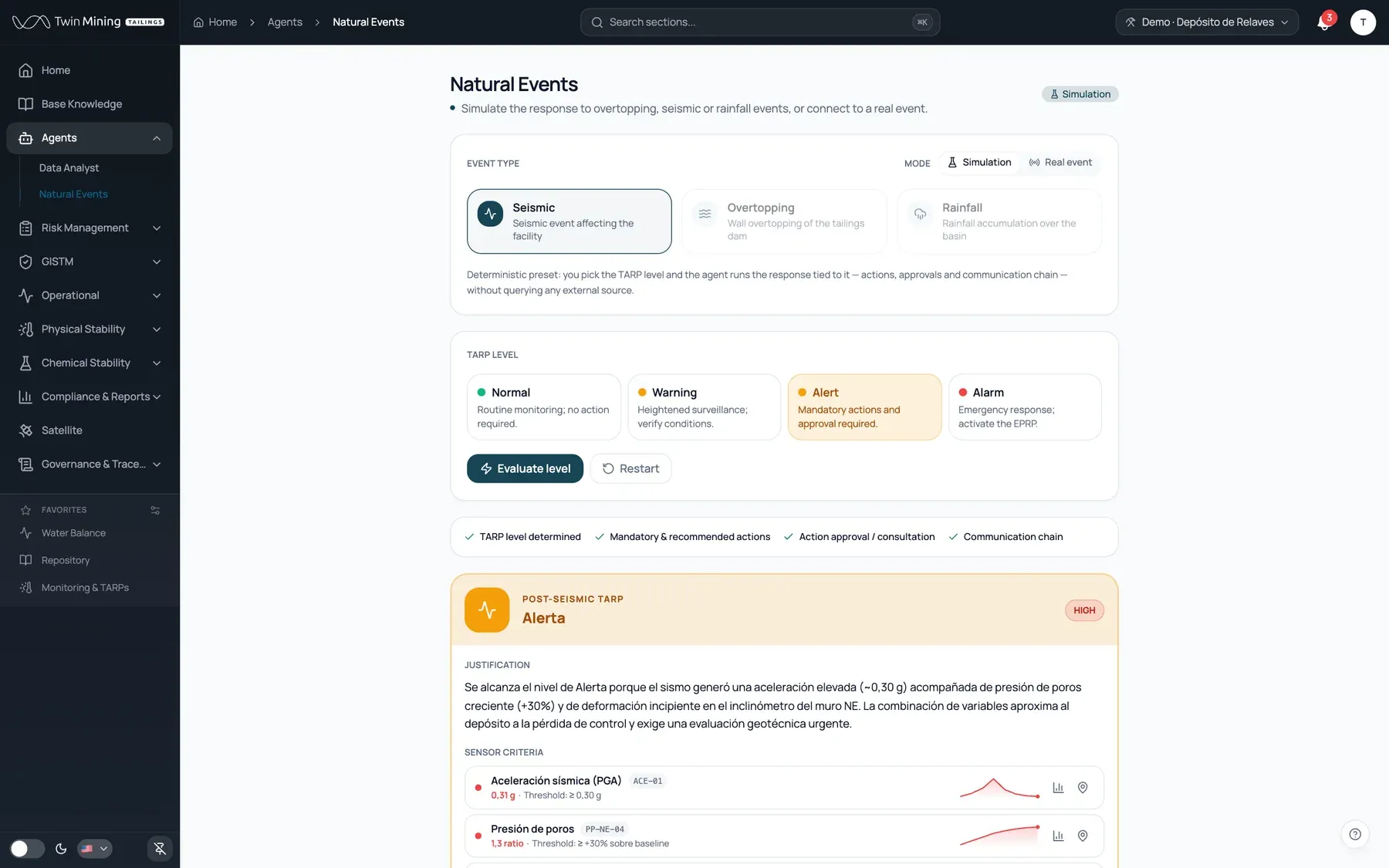
After a seismic event, the agent walks the post-seismic TARP level by level and proposes the actions of the applicable protocol, with the event record and the affected sensors. Threshold and response on the same screen; the decision stays with the person.
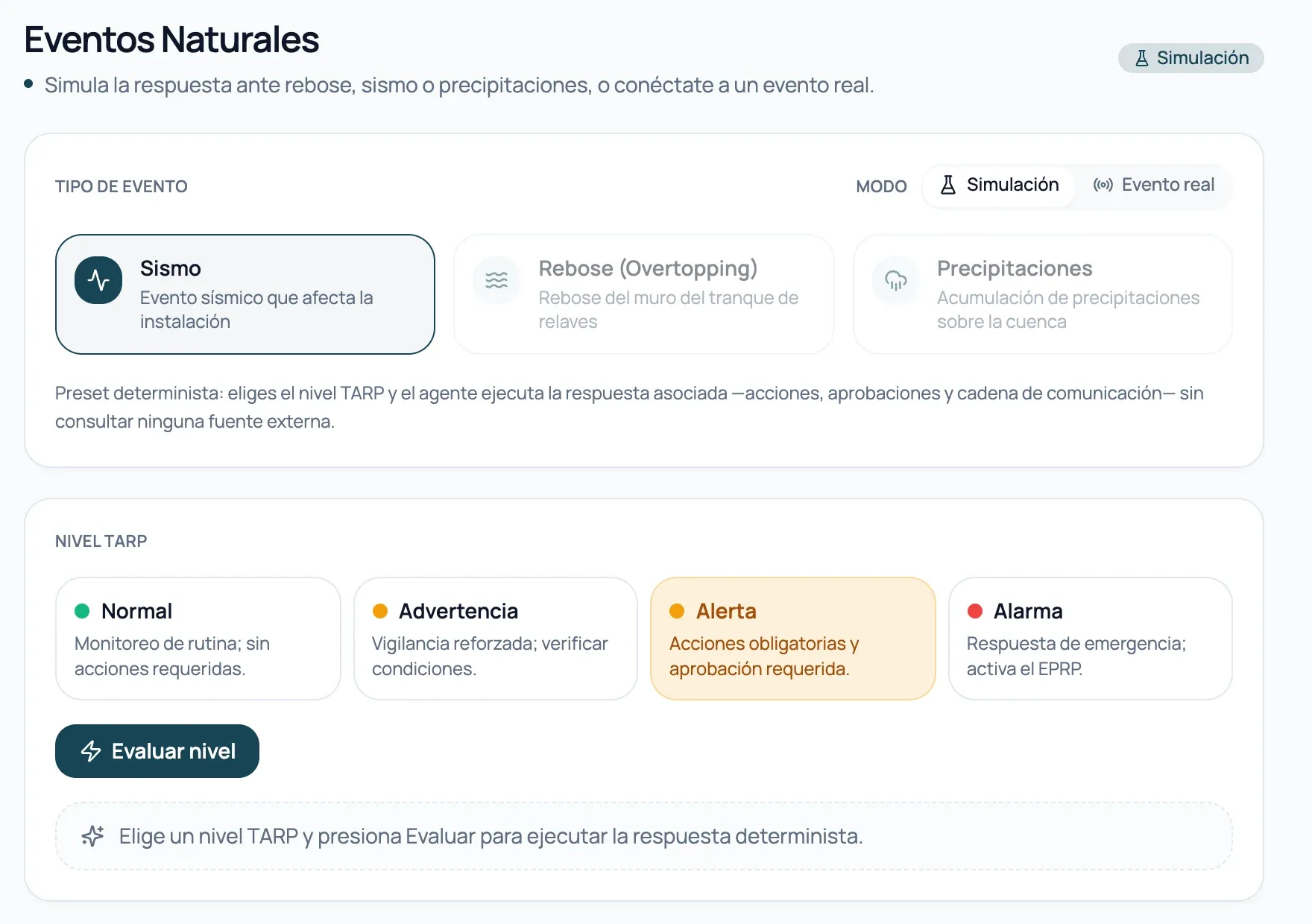
Threshold and response on the same screen. The module's whole argument in one image. -
Conversational data analyst
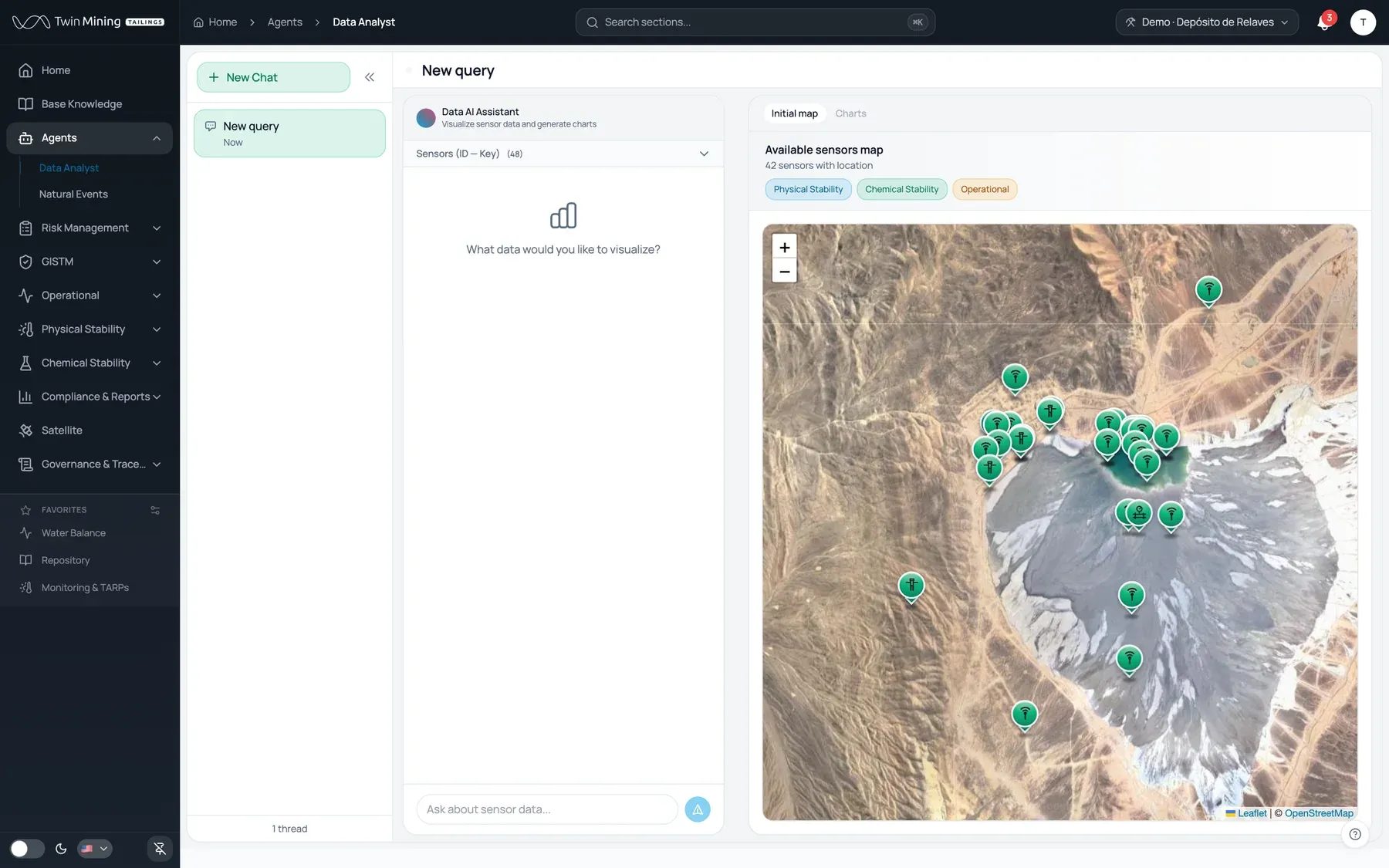
It works over the facility's data and produces charts and sheets inside the same screen, without leaving for another tool. The query goes through the specialized-agent dispatcher, not through free-form queries against the database.
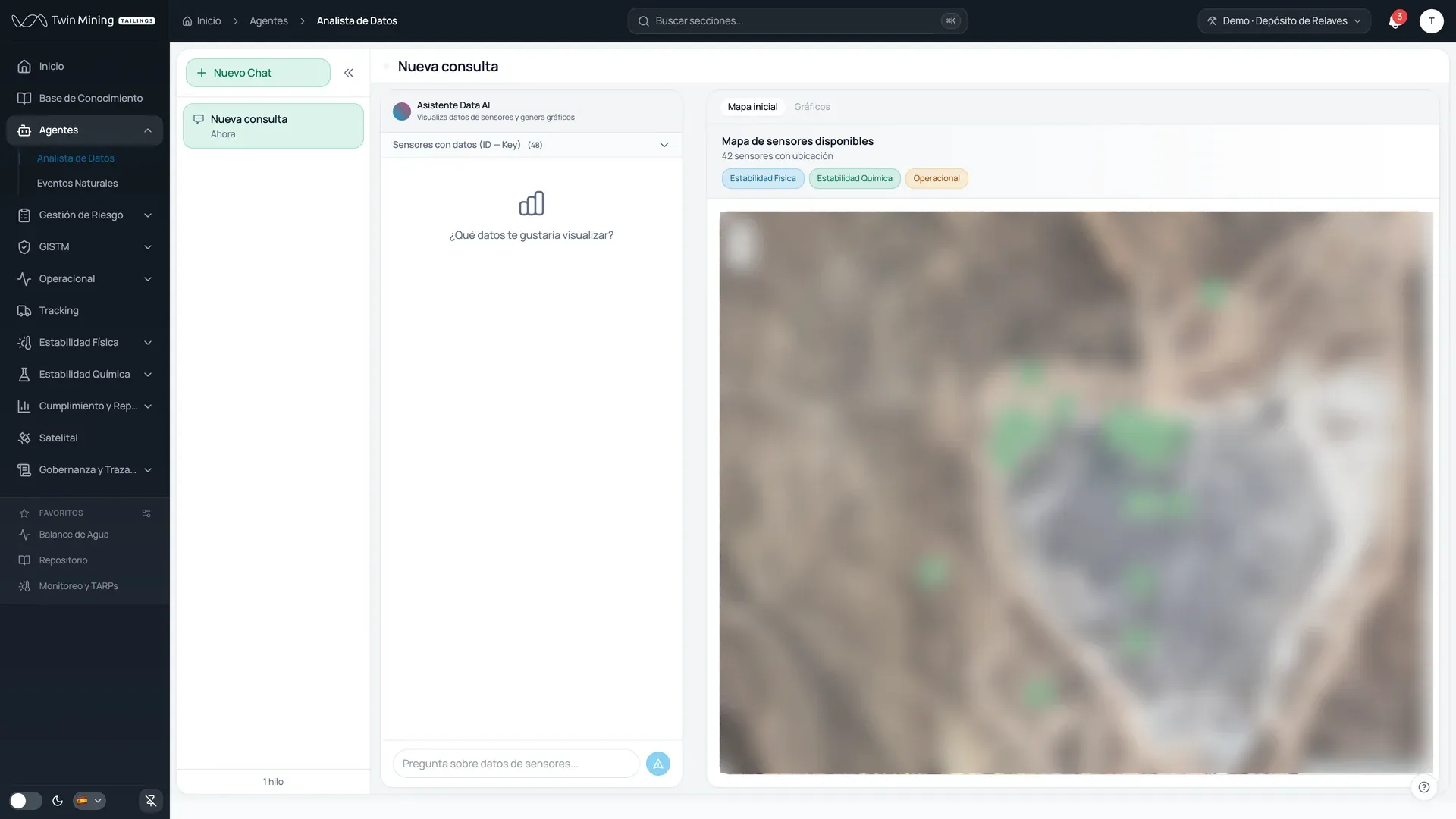
The chart on the right was produced by the conversation beside it. No export to another tool in between. -
An audit trail of the agents
There is a log of what the agents did, with the agent's name, the model and the prompt version of each run. A verdict without a prompt version would be an anonymous opinion.
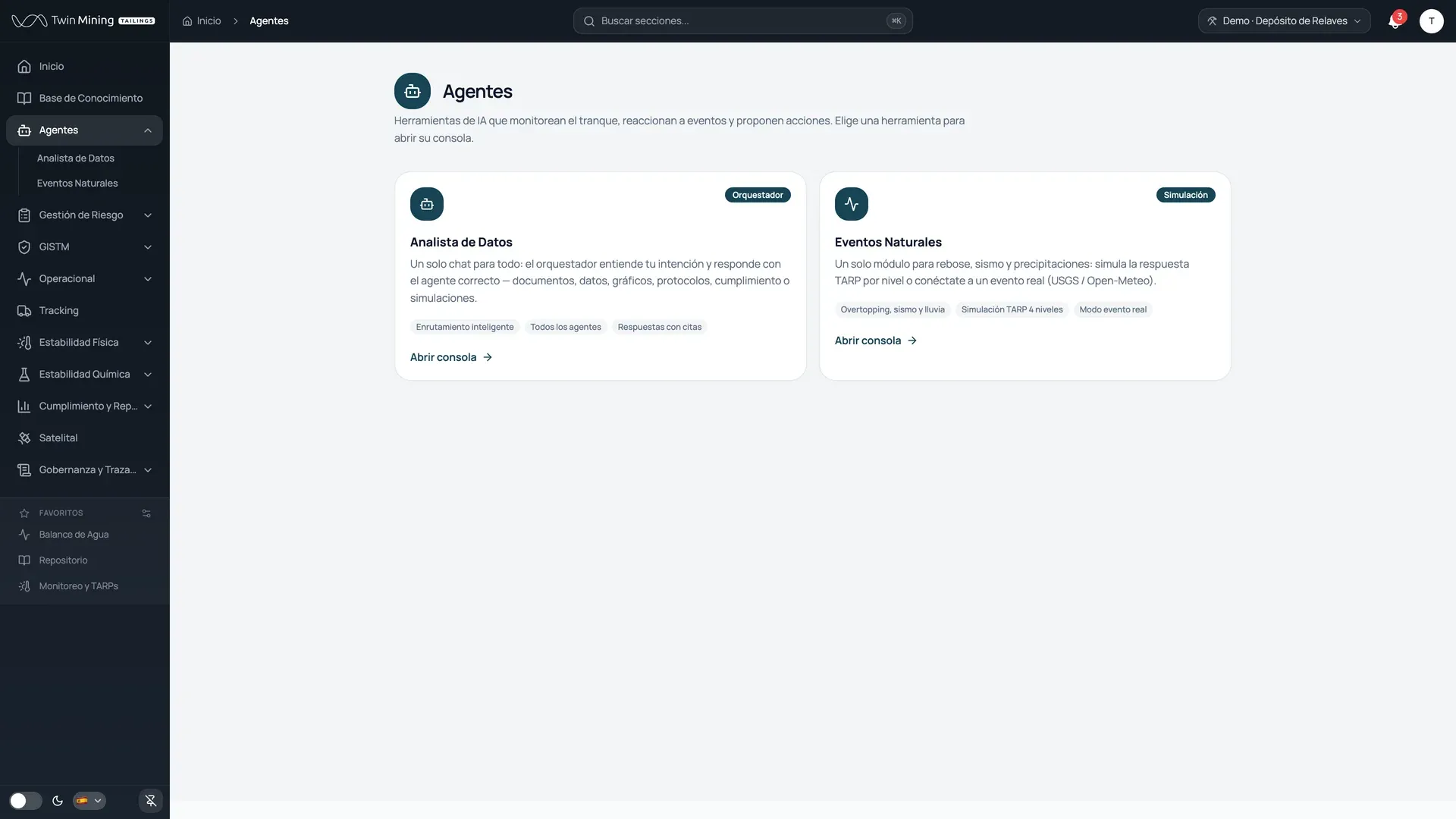
Presented by task, not by technology.
-
They propose, cite and sign; they do not decide
Agents propose, cite the source with document and page, and sign with their model and prompt version. They never decide: human confirmation is a separate event, and only that one moves the state.
-
Reasoning and citation are protocol, not decoration
The agent's reasoning and its citations are first-class events on the channel — start, thought, text, citation, end — not text pasted at the end. The screen shows them as they arrive.
The agent prepares. The person signs. And that is not a policy: it is in the data model.
Scope
What it decides and what it does not
What it works out on its own
It prepares. It reads the corpus by document type, the sensors and their bands, the public seismic catalogue, the standard and its requirements; it walks the applicable protocol and proposes the actions. Everything it does is logged with its name, model and prompt version, so a proposal from three months ago can be attributed and therefore challenged.
What it never decides
Nothing. And not out of commercial caution: by architecture. In management of change, an agent's suggestion enters a state that blocks until a person confirms it, and that confirmation is a second event with its own author and date. An agent never takes part in evaluating state transitions.
Honesty
What it does not do yet, on purpose.
We would rather say it before the first meeting.
- They do not predict, detect or anticipate a failure. They read documents, time series and public seismic catalogues, and walk a protocol a person wrote. It is the hardest rule to keep, and what there is is easier to defend.
- The agent does not execute: it does not create the change, move the state or notify the team. It prepares the record and leaves it in draft for a person to sign. That is an architecture decision, not a gap.
- In the demo, of the natural events only earthquake opens. Rain and overtopping exist and appear in the selector, but are disabled: a live demonstration shows one, not three.
- If the model breaks the output format, the screen shows the prose. It never fills half a table: an invented row on a compliance screen is worse than no row.
Who it is for
Who comes in through here
- RTFE — Responsible Tailings Facility Engineer Something crosses a threshold and they find out late.
- Geotechnical engineer A value they know is written down in some report.
- Site or shift supervisor A shift that starts without knowing what to look at.
- Independent reviewer / auditor That the trail does not exist.
Frequently asked questions
What people usually ask about this module
Short answers with no overclaiming. If something is not built yet, we say so.
Who is accountable if a Twin Mining AI agent gets it wrong?
The same person who was accountable before. The agent did not change who signs; it changed how long it takes to have the protocol in front of you. Agents propose, cite the document and page, and sign with their model and prompt version. They never decide: in management of change, a suggestion enters a state that blocks until a person confirms it, and that confirmation is a second event with its own author and date.
A chatbot does not end up in a hash-chained log with its prompt version, nor does it enter a workflow that blocks until someone confirms. Here, a proposal from three months ago can be attributed to a specific agent, model and version, and therefore challenged.
What does the natural-events agent do after an earthquake?
It walks the protocol that already existed, at the moment it is needed, without anyone hunting for the PDF. After a seismic event, the agent walks the post-seismic TARP level by level and proposes the actions of the applicable protocol, with the event record and the affected sensors. Threshold and response end up on the same screen; the decision, and the signature, remain with the person.
It does not predict or detect a failure: it reads documents, time series and the public seismic catalogue, and follows a protocol a person wrote. In the demo only the earthquake event opens; rain and overtopping exist and appear in the selector, but are disabled.
Does Twin Mining's artificial intelligence make decisions on its own?
No. Agents propose and cite; people decide. This is not a stated policy: it is in the data model. An agent suggestion enters a state that blocks until a person confirms it, and that confirmation is a second event with its own author and timestamp.
An agent never takes part in evaluating state transitions, and every verdict is signed with the model and prompt version that produced it, so an external reviewer can reconstruct where it came from.
Nothing is inferred from nothing either: every edge of the impact graph corresponds to a real relationship in the data model and declares whether it is stated or derived. Deterministic computation first, model narration second — inverting that order would let the model invent the pattern with no way to check it.
Does Twin Mining TMS predict tailings dam failures or collapses?
No, and it is worth saying plainly: the platform contains no model that predicts the failure of a tailings storage facility. Any vendor claiming otherwise is making a promise an Engineer of Record will take apart in the first technical meeting.
What Twin Mining TMS does do is shorten the time between a reading changing and someone looking at it: thresholds a specialist defined, time series with their bands, anomaly detection over the historical record, and agents that read the facility's documentation and propose with the source cited.
Deciding what a deviation means and what to do about it remains with the accountable people: the RTFE, the EoR, and the site organization.
Other modules
What connects with this module.
- Management of Change We know who signed. We don't know what they had in front of them when they signed. That is the problem. See the module →
- GISTM Your GISTM self-assessment is green. When did anyone last open the document that supports it? See the module →
- Knowledge Base "It's in the stability report" is not an answer. "Page 47, revision C" is. See the module →
- Operations Your facility's water balance lives in a spreadsheet that only one person understands. See the module →
- Physical Stability The engineer thinks about the dam in section. Monitoring software shows it in plan. See the module →
- Twin Model Fleet in one system, works in the contractor's drawings, facility in another. Where do you see them together? See the module →
Request a demonstration
Let's talk about your facility.
Tell us which facility you manage and what keeps you up at night. We will walk you through the demonstration environment with someone from the team, module by module, and tell you frankly what is built and what is not.
- We reply within 24 business hours
- Guided demonstration, tailored to your operation
- No commitment. There is no public price: we talk