Module
GISTM Turn a 77-requirement standard into a queryable state: what was declared, which evidence supports it, who answers for it, and which external reviewer will look at it and when.
Your GISTM self-assessment is green. When did anyone last open the document that supports it?
The problem
What happens today at a facility
Today the GISTM self-assessment lives in a spreadsheet one person updates before each review. Status and evidence sit in different places — the green in a cell, the document in a shared folder — so a requirement can stay green for months on the strength of a report that expired, or one nobody signed. Nobody notices until the independent reviewer asks.
And it is not a tidiness problem: it is a problem of who can answer. The standard demands accredited, current roles. When the compliance lead has to explain where a green came from, the honest answer is usually "someone who no longer holds the role set it, in a review of which no record remains".
Twin Mining TMS does not say whether you conform. It organizes the evidence that supports conformance in front of an external reviewer, requirement by requirement, and shows where the declared status and the documentation do not match.
What it does
Capabilities, with their nuance.
-
Declared versus evidence, row by row
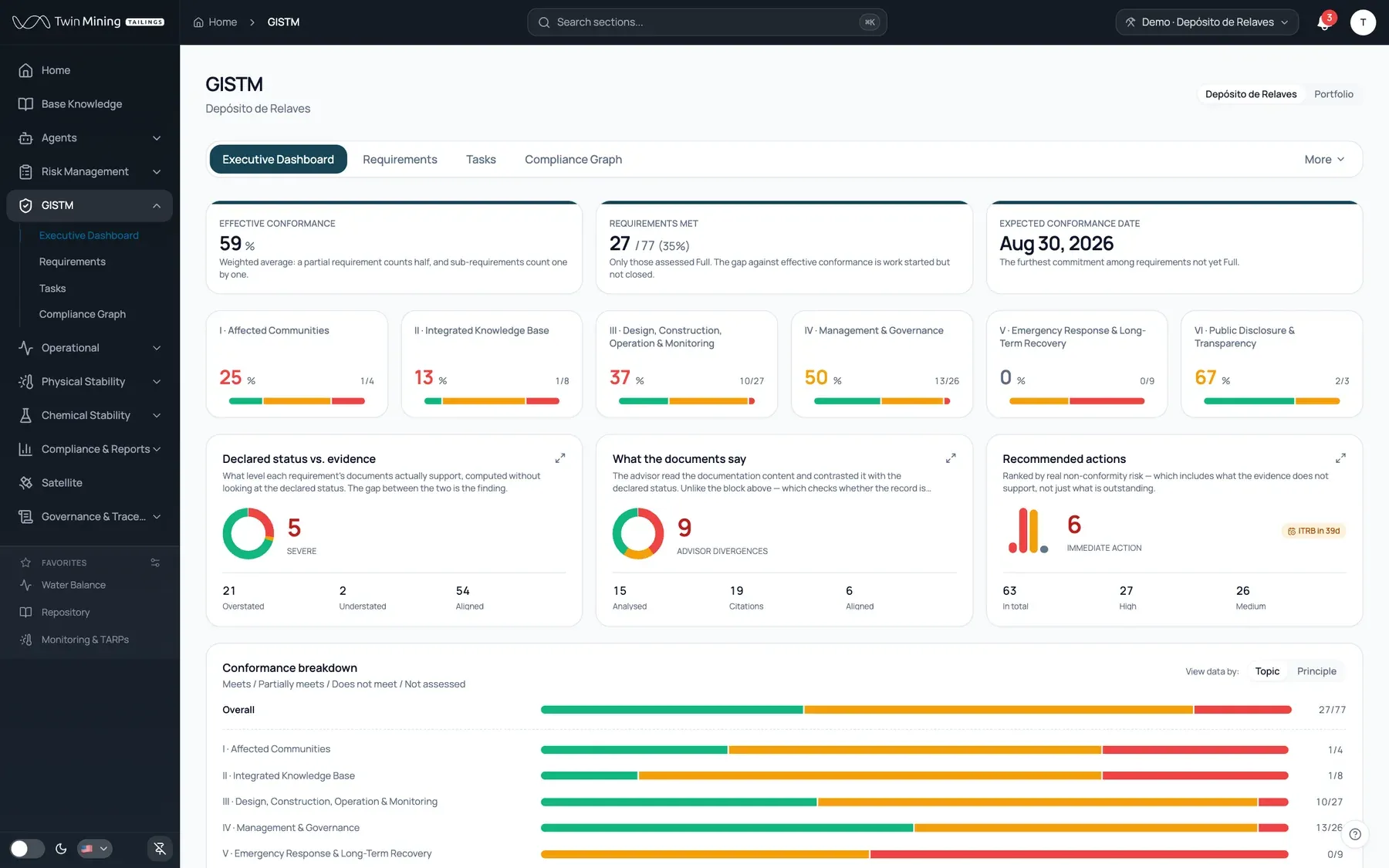
A deterministic rule — not a model's judgement — checks the declared status against the attached evidence and flags divergences in the table itself: over-declared, not supported by the documents. The divergences-only checkbox turns the table into the work list.
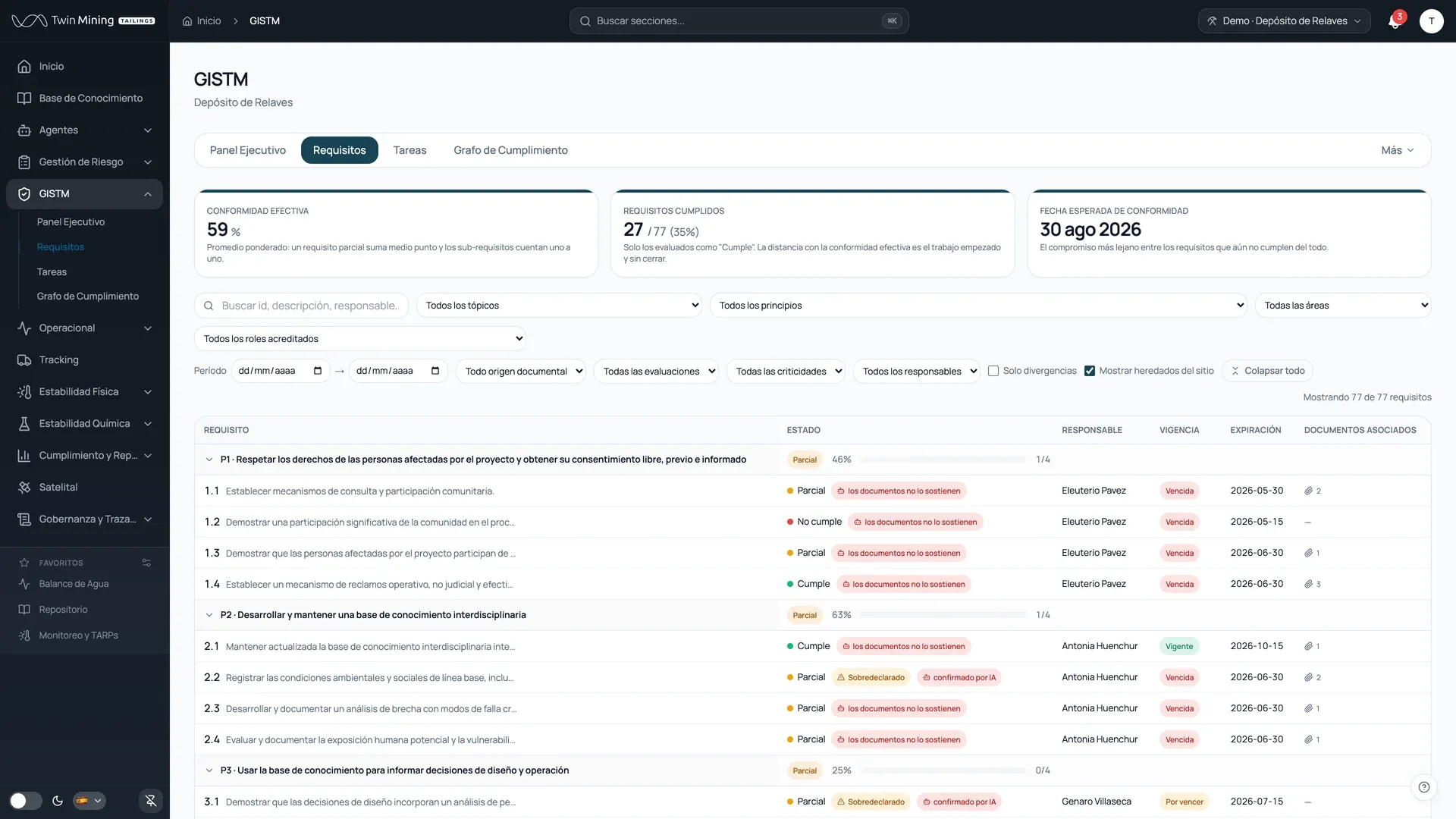
A green requirement with an over-declared badge beside it tells the product's story without a single word of marketing. -
The org chart is a compliance artefact
Roles, appointments and their validity, with the independent review panel on its own branch. An empty role or an expired appointment is visible, and that is information: the standard treats a change of Engineer of Record as a management-of-change event.
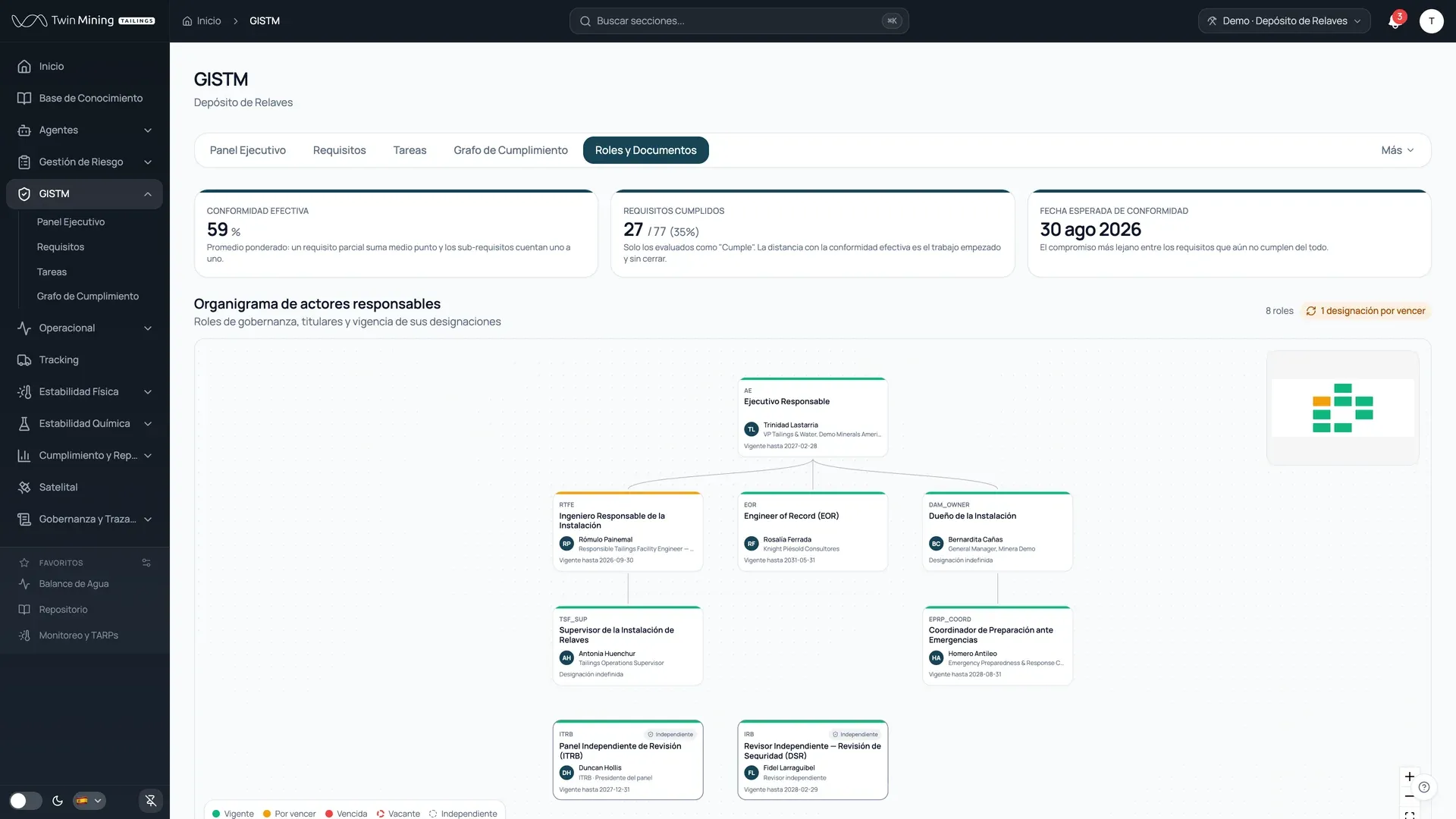
Roles with nobody appointed show as empty, and that is information, not a demo glitch. -
Lessons learned tied to the requirement
A library of lessons from public industry incidents, tied to the requirements they affect, with preventive actions that become tasks. Opening a requirement also answers "what has the industry already learned about this?".
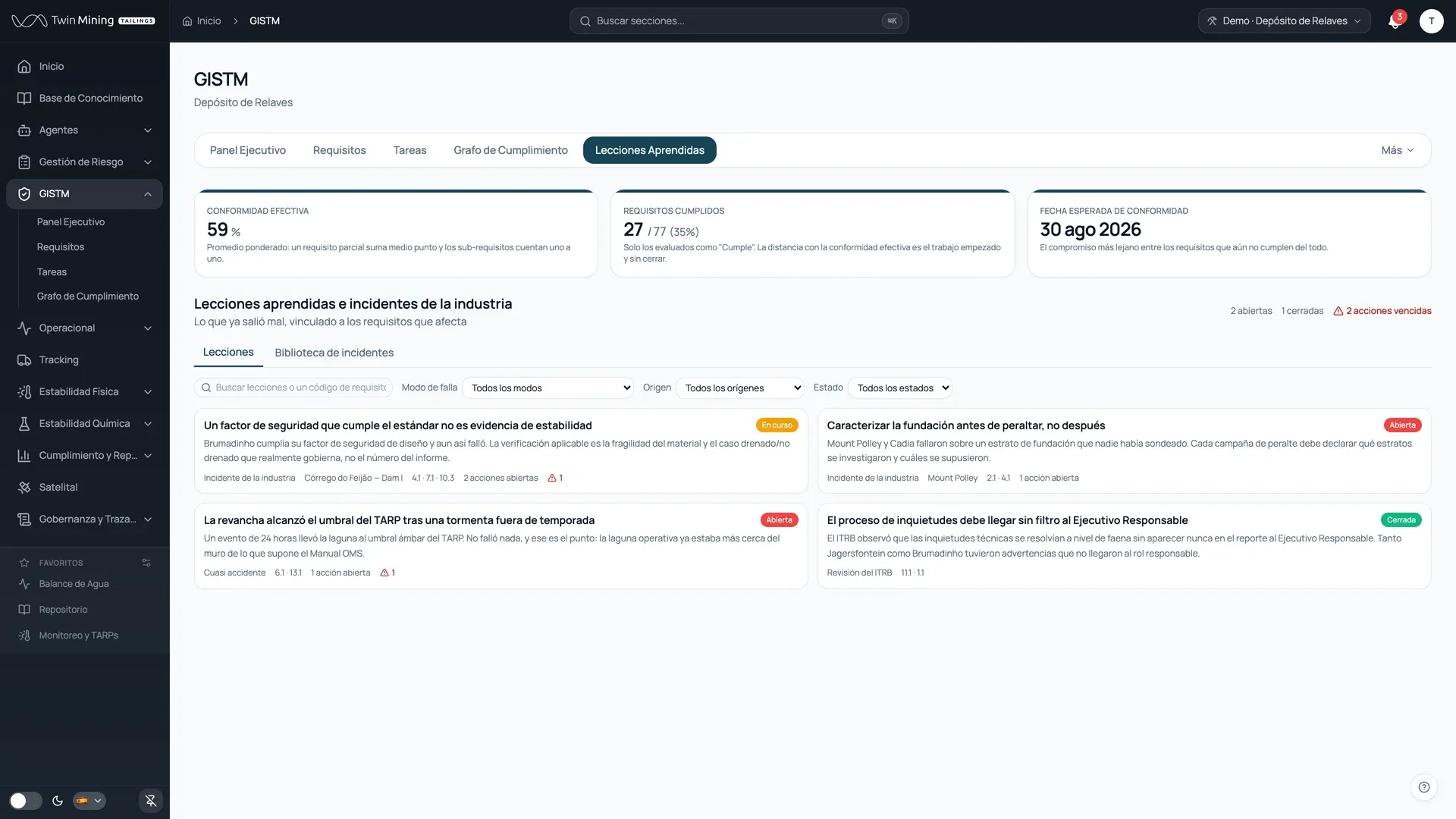
Each lesson is tied to the requirement that would have prevented the incident.
-
The standard comes preloaded
15 principles and 77 requirements, with their sub-requirements, without the client having to transcribe them. It is the real head start: nobody copies 77 requirements into a spreadsheet before seeing anything.
-
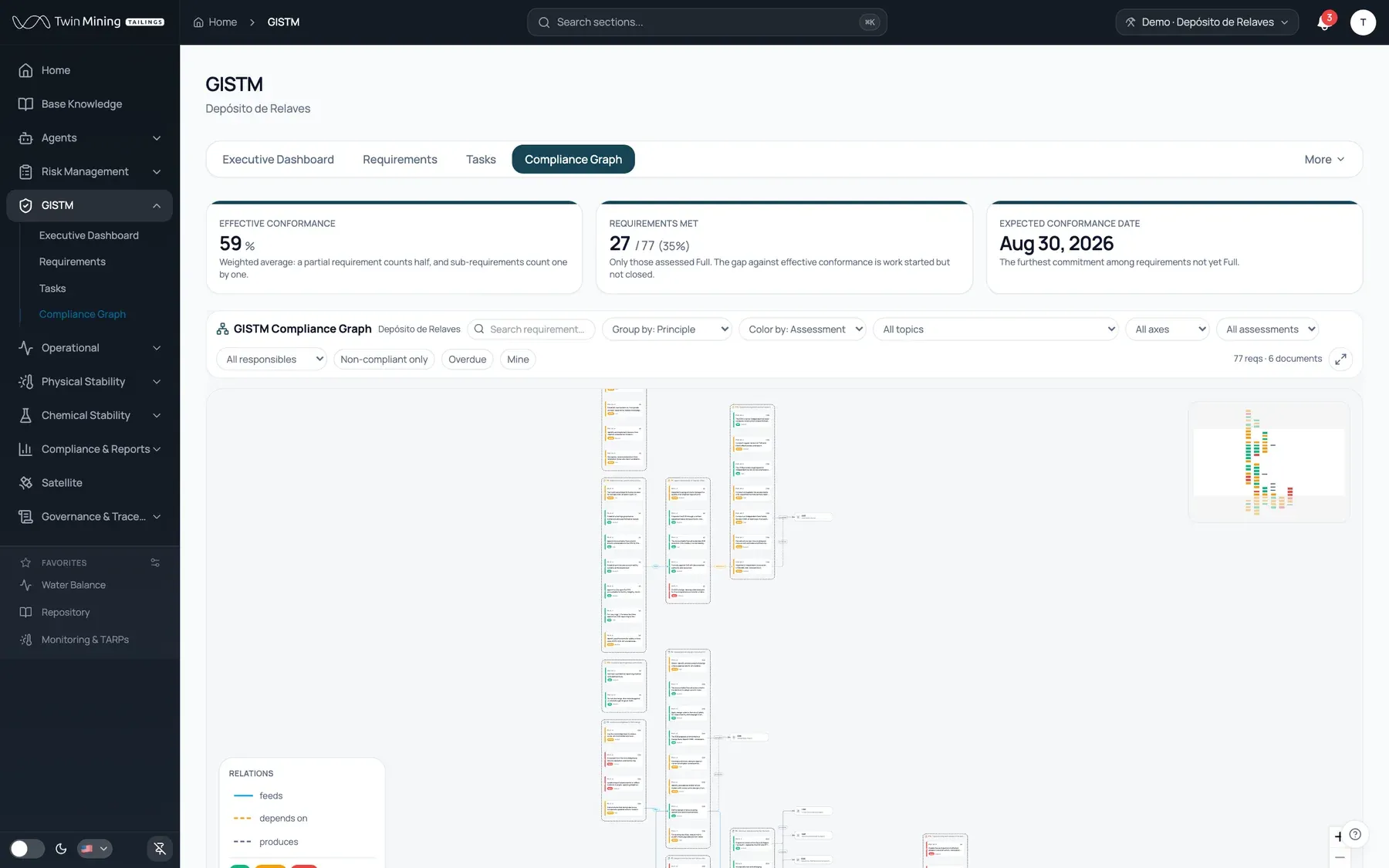
Topic → principle → requirement, with its evidence
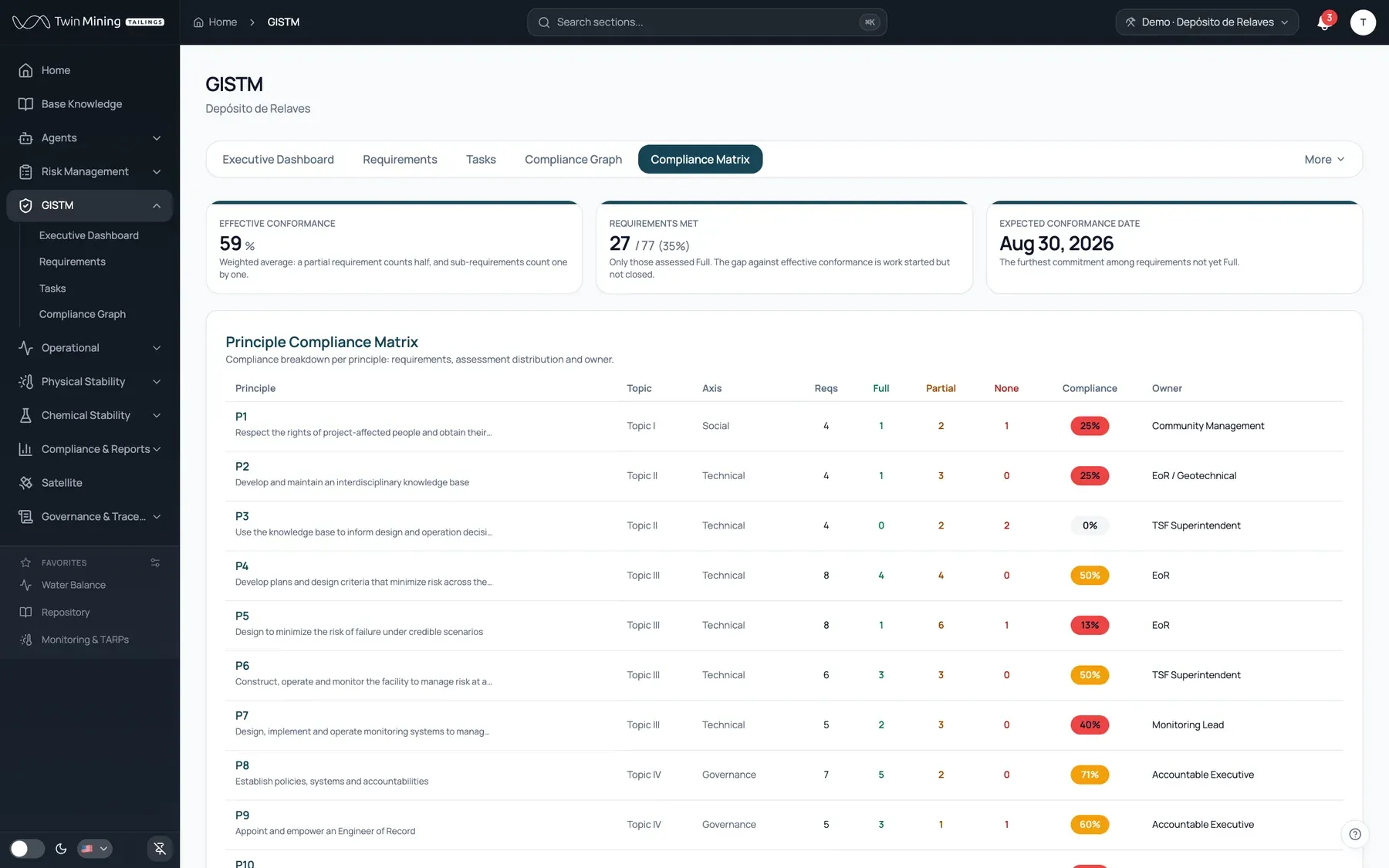
It walks the structure of the standard and stores each requirement's self-assessment status with the documentary evidence behind it. The topic-by-principle matrix reads without any text.
-
An AI verdict with a signature
An agent reads a requirement's evidence, proposes a verdict on whether it really proves it, cites the document and page, and signs it with its model and prompt version. It is shown beside the declared status, never in its place; a person decides. If the model breaks the output format, the screen shows the prose instead of filling half a table.
-
Compare facilities
A portfolio view compares the facilities in the demonstration environment, with a ranking and detection of the recurring gap and of the practice that can be transferred. The matching is deterministic; the model only drafts how to transfer the practice.
77 requirements. One spreadsheet. One person. And an independent review in March.
Scope
What it decides and what it does not
What it works out on its own
A deterministic rule compares the declared status against the attached evidence — it looks only at files, dates and signatures — and flags the divergence. With no evidence, the ceiling is "None"; with undated or unapproved evidence, the ceiling is "Partial": having it is not the same as someone having answered for it. Separately, an agent reads the evidence, proposes a verdict on whether it really proves the requirement, and signs it with its model and prompt version.
What it never decides
It does not decide whether a requirement conforms. A person declares that. The agent's verdict is shown beside the declared status, never in its place, and conformance is verified by an independent reviewer, not by the software.
Honesty
What it does not do yet, on purpose.
We would rather say it before the first meeting.
- The software does not say whether you conform. The operator declares conformance and an independent reviewer verifies it; what the module does is organize the evidence that supports it.
- Divergence detection is a rule, not the AI. It looks at files, dates and signatures. The model comes afterwards, to interpret the evidence, and signs what it proposes. Merging the two would sell something the product does not do that way.
- Today the standard comes preloaded and is not configurable: requirements, scales and periodicities cannot be adapted to an internal framework. That is a head start and a real limitation.
- There is an audit tab; per-profile reports (board, Engineer of Record, regulator) are not there yet. What exists is the conformance matrix and the evidence package.
- "Portfolio" in the demo means four facilities. We can talk about the mechanics — compare, rank, spot the recurring gap — without implying a scale that is not there.
Who it is for
Who comes in through here
- RTFE — Responsible Tailings Facility Engineer Something crosses a threshold and they find out late.
- Engineer of Record Something that compromises their design gets changed without anyone asking them.
- Corporate compliance lead Having to explain where a green came from in front of the reviewer.
- Dam Owner / Accountable Executive The portfolio: which facility is worst off, and why.
Frequently asked questions
What people usually ask about this module
Short answers with no overclaiming. If something is not built yet, we say so.
Does Twin Mining TMS certify GISTM conformance?
No, and no software can. The operator declares conformance and an independent reviewer verifies it. What the module does is organize the evidence that supports that conformance in front of the external reviewer, requirement by requirement, and show where the declared status and the documentation do not match.
A consultancy produces the report once a year; this is the state between reports, which is what the reviewer asks about. A spreadsheet does not know the document expired; the module does, because a deterministic rule checks the declared status against the attached files, dates and signatures.
What exactly does the AI agent do in the GISTM module? Does it decide for me?
It does not decide. Two things the module does differently are worth separating. First, a deterministic rule — not the AI — compares the declared status against the attached evidence, looking only at files, dates and signatures, and flags the divergence. Second, an agent reads a requirement's evidence, proposes a verdict on whether it really proves it, cites the document and page, and signs it with its model and prompt version.
The verdict is shown beside the declared status, never in its place; a person decides. And if the model breaks the output format, the screen shows the prose instead of filling half a table: an invented row on a compliance screen is worse than no row.
What is the GISTM and what does it require from tailings operators?
The GISTM (Global Industry Standard on Tailings Management) is the global tailings standard published in 2020 following the Brumadinho collapse. It is structured into 6 topics, 15 principles, and 77 requirements, and major mining operators publicly committed to conform to it.
Among other things it requires an interdisciplinary knowledge base for the facility, a designated and empowered Engineer of Record (EoR), a Responsible Tailings Facility Engineer (RTFE), an Independent Tailings Review Board (ITRB), and traceable evidence that each requirement was assessed and by whom.
Conformance is declared by the operator and verified by an independent reviewer: no software can certify it. What Twin Mining TMS does is organize the evidence that supports that conformance in front of the external reviewer, requirement by requirement.
Is Twin Mining Tailings aligned with international standards such as GISTM?
Yes. The platform is aligned with the principles of the Global Industry Standard on Tailings Management (GISTM) and helps operationalize the self-assessment of its 77 requirements.
It structures processes, controls, evidence, and workflows to assess adherence to all 15 principles with traceability and audit-ready records, and makes visible the gap between what can already be defended and what cannot yet.
No software certifies or guarantees GISTM conformance: the operator declares it and an independent reviewer verifies it. What the platform organizes is the evidence that declaration is defended with.
Other modules
What connects with this module.
- Management of Change We know who signed. We don't know what they had in front of them when they signed. That is the problem. See the module →
- Knowledge Base "It's in the stability report" is not an answer. "Page 47, revision C" is. See the module →
- Agents It's three in the morning and the ground just shook. Where is the TARP? See the module →
- Operations Your facility's water balance lives in a spreadsheet that only one person understands. See the module →
- Physical Stability The engineer thinks about the dam in section. Monitoring software shows it in plan. See the module →
- Twin Model Fleet in one system, works in the contractor's drawings, facility in another. Where do you see them together? See the module →
Request a demonstration
Let's talk about your facility.
Tell us which facility you manage and what keeps you up at night. We will walk you through the demonstration environment with someone from the team, module by module, and tell you frankly what is built and what is not.
- We reply within 24 business hours
- Guided demonstration, tailored to your operation
- No commitment. There is no public price: we talk